FREE SHIPPING On Orders Over US$200
Fiber optic and copper cables are both essential to modern networks, but they solve different connectivity problems.
Copper twisted-pair cabling remains widely used for computers, Wi-Fi access points, IP cameras and other devices that need standard RJ45 connectivity or Power over Ethernet. Direct-attach copper cables provide economical, low-power connections between switches and servers over very short distances.
Fiber optic cable becomes more attractive when the network requires:
- Longer transmission distances
- Higher port density
- Electrical isolation
- Immunity to electromagnetic interference
- Lower cable weight at high data rates
- Greater flexibility for future bandwidth upgrades
The correct choice is rarely based on speed alone. Distance, equipment interfaces, power requirements, pathway capacity, installation cost and upgrade plans must all be considered.
Quick Answer
Choose twisted-pair copper cable when:
- Devices use RJ45 ports.
- Cable runs remain within the applicable Ethernet distance.
- PoE is required.
- The installation serves desktops, access points, cameras or phones.
- Simple field termination is important.
Choose direct-attach copper cable when:
- The connection is inside one rack or between adjacent racks.
- Both devices have compatible SFP, QSFP or OSFP ports.
- The shortest possible high-speed connection is required.
- Low initial cost and low power consumption are priorities.
Choose fiber optic cable when:
- The distance exceeds copper limits.
- The environment has strong electromagnetic interference.
- Connections run between buildings.
- High fiber density or very high bandwidth is required.
- Electrical isolation is important.
- The cabling infrastructure must support several technology generations.
First, Define “Copper Ethernet Cable”
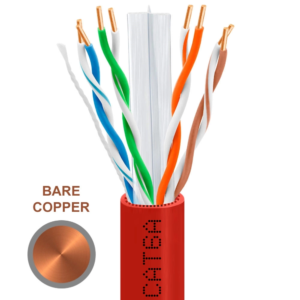
The term copper Ethernet cable can refer to two substantially different products.
Balanced Twisted-Pair Cable
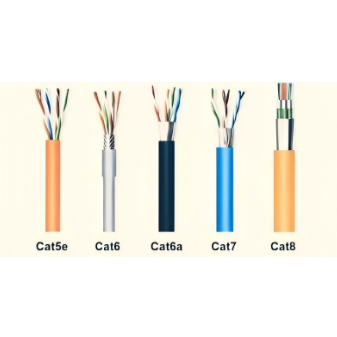
This is conventional Category cabling, including:
- Cat5e
- Cat6
- Cat6A
- Cat8
It normally uses RJ45-compatible interfaces and supports applications such as:
- 1000BASE-T
- 2.5GBASE-T
- 5GBASE-T
- 10GBASE-T
- 25GBASE-T
- 40GBASE-T
Category cabling is commonly installed as permanent horizontal cabling inside homes, offices, factories and data centers.
Direct-Attach Copper Cable
A Direct-Attach Copper cable, or DAC, is a twinaxial cable assembly with integrated transceiver-style connectors such as:
- SFP+
- SFP28
- QSFP+
- QSFP28
- QSFP-DD
- OSFP
DAC is mainly used for short server-to-switch and switch-to-switch connections.
A DAC is not an RJ45 Category cable. Its supported distance, port type and application are different.
This distinction is important because saying “copper supports only 40G” ignores current 100G and 400G DAC assemblies. Cisco, for example, currently specifies passive 400G QSFP-DD DAC solutions in lengths from 0.5 to 3 meters.
Fiber vs. Twisted Pair vs. DAC
| Feature | Fiber Optic Cable | Twisted-Pair Copper | Direct-Attach Copper |
|---|---|---|---|
| Signal type | Optical | Electrical | Electrical |
| Common interface | LC, MPO/MTP, CS, SN and others | RJ45 | SFP/QSFP/OSFP-family connectors |
| Typical distance | Meters to many kilometers, depending on optics | Up to 100 m for many applications; 30 m for Cat8 25G/40G | Normally a few meters |
| Common data rates | 1G through 800G and beyond, depending on optics | Commonly 1G–10G; Cat8 supports 25G/40G over short channels | 10G through 400G and higher, product-dependent |
| EMI susceptibility | Optical path is immune | Can be affected; construction and shielding matter | Can be affected, but used over short controlled paths |
| Electrical isolation | Yes with all-dielectric cable | No | No |
| Power delivery | No conventional PoE | Supports PoE | Does not normally provide endpoint PoE |
| Cable size at high rates | Generally small and lightweight | Larger at higher categories | Thicker and heavier as rate or length increases |
| Field termination | Requires fiber-specific tools and skills | Relatively straightforward | Factory-terminated |
| Best use | Longer, high-density or electrically noisy links | Horizontal building cabling and powered endpoints | Very short data center links |
1. Signal Transmission
Fiber optic cable transmits information as modulated light through a glass or plastic optical waveguide.
Copper cable transmits electrical signals through conductive pairs or twinaxial conductors.
The optical cable does not perform the electrical-to-optical conversion itself. That function is handled by active devices such as:
- Optical transceivers
- Media converters
- Network switches
- Optical line terminals
- Fiber network adapters
This distinction matters because the complete performance of a fiber link depends on both the passive cable and the active optical modules.
2. Transmission Distance
Twisted-Pair Copper Distance
A structured copper channel commonly has a maximum length of 100 meters, usually consisting of:
- Up to 90 meters of permanent horizontal cable
- Patch cords and equipment cords making up the remaining channel length
For new 10GBASE-T installations requiring the full 100-meter channel, Cat6A is the recommended category. Existing Cat6 may support 10G over shorter distances, but performance between approximately 37 and 55 meters depends on alien crosstalk and installation conditions.
Cat8 uses a different short-channel topology. IEEE development material for 25GBASE-T and 40GBASE-T specifies balanced Category 8 or Class I/II cabling with a maximum channel length of approximately 30 meters and no more than two connectors.
DAC Distance
Passive DAC is designed primarily for connections within one rack or between adjacent racks.
Current Cisco 400G passive DAC products are offered in lengths up to approximately 3 meters. Longer short-reach connections may use active copper cables or active optical cables, depending on the platform.
Fiber Distance
Fiber does not have one universal maximum distance.
The supported distance depends on:
- Single-mode or multimode fiber
- Optical wavelength
- Transceiver standard
- Launch power
- Receiver sensitivity
- Connector and splice loss
- Modulation format
- Forward error correction
- Amplification and regeneration
Current 400G examples include:
- 50 m over multimode fiber using a parallel MPO interface
- 500 m over parallel single-mode fiber
- 2 km over duplex single-mode fiber and LC connectors
Current 800G examples include:
- 30 m over OM3 multimode fiber
- 50 m over OM4 or OM5
- 500 m over parallel single-mode fiber
- 2 km for certain dual-duplex single-mode configurations
For longer metro and long-haul networks, coherent optics, optical amplifiers and transport systems can extend transmission far beyond ordinary client-optics distances.
3. Bandwidth and Data Rate
It is incorrect to assign one maximum data rate to either material.
The supported rate is determined by the complete signaling system.
Copper Examples
Copper can support:
- 1G, 2.5G, 5G and 10G over Category cabling
- 25GBASE-T and 40GBASE-T over short Cat8 channels
- 100G and 400G over short DAC assemblies
Fiber Examples
Fiber can support:
- Low-speed industrial and sensing systems
- 1G, 10G and 25G duplex links
- 40G and 100G parallel or wavelength-multiplexed links
- 200G, 400G and 800G optical systems
- Long-haul coherent transmission
Current 400G modules may use MPO-12, MPO-16 or duplex LC depending on the optical standard. Therefore, “400G” alone is not enough information to select the cable.
4. Propagation Speed and Latency
Electrical signals in copper and light signals in glass both propagate at a substantial fraction of the speed of light in vacuum.
The fact that one medium may have a slightly higher propagation velocity does not determine its maximum Ethernet rate.
Data rate depends more heavily on:
- Signaling bandwidth
- Modulation
- Noise and crosstalk
- Transceiver electronics
- Forward error correction
- Receiver sensitivity
- Channel quality
For most enterprise and data center decisions, raw propagation velocity should not determine the cable choice.
End-to-end latency may also include:
- Serialization delay
- FEC processing
- Transceiver processing
- Switch forwarding
- Queuing
- Application processing
For extremely latency-sensitive, very short data center links, passive DAC is often evaluated because it uses a direct electrical path without separate optical conversion. For longer distances, fiber normally becomes the practical option.
5. Electromagnetic Interference
The optical transmission path does not carry electrical current and is immune to electromagnetic interference.
This makes fiber particularly suitable near:
- Motors
- Transformers
- High-voltage cables
- Variable-frequency drives
- Radar systems
- Industrial machinery
- Electrical substations
Corning identifies EMI immunity as a fundamental advantage of optical fiber because the medium carries light rather than electricity.
Twisted-pair copper reduces interference through balanced signaling and twisted conductors. Shielded cable can provide additional protection, but performance depends on:
- Cable construction
- Connector quality
- Bonding and grounding
- Separation from electrical equipment
- Installation workmanship
Copper should therefore not be described as having the same inherent interference immunity as fiber.
6. Power over Ethernet
A major advantage of twisted-pair copper is its ability to carry data and electrical power over the same cable.
PoE is commonly used for:
- Wireless access points
- IP cameras
- VoIP phones
- Access-control devices
- Building-automation equipment
- Digital signage
- Sensors
IEEE 802.3bt expanded PoE to use all four twisted pairs.
Fiber optic cable does not provide conventional PoE because the glass fiber is not an electrical conductor.
A fiber-connected remote device therefore requires:
- Local electrical power
- A separate power cable
- A hybrid fiber-and-power cable
- A specialized power-over-fiber system
Copper does not act as a battery. If the PoE switch loses power, the powered device also loses power unless the switch or injector is supported by a UPS or another backup source.
7. Electrical Isolation
An all-dielectric fiber cable provides no conductive path between two network locations.
This can reduce risks associated with:
- Ground-potential differences
- Lightning-induced current
- Electrical faults
- Building-to-building grounding
- High-voltage environments
This is one reason fiber is frequently preferred for campus links, substations and industrial facilities.
Metal-armored fiber cable may contain conductive components, so its bonding and grounding requirements must be evaluated separately.
8. Cable Size, Weight and Density
At high data rates, fiber cables and active optical cables are generally thinner and lighter than equivalent long copper assemblies.
Cisco notes that its 400G AOCs are thinner and lighter than copper cables, helping cable management and airflow in high-density racks.
This becomes important when hundreds of links pass through:
- Overhead trays
- Underfloor pathways
- Vertical managers
- High-density switch cabinets
- Spine-and-leaf networks
DAC remains practical for very short connections, but higher-rate and longer copper assemblies can become thick and difficult to route.
9. Mechanical Durability
Copper conductors are generally tolerant of ordinary handling, although excessive bending, pulling or connector damage can still degrade performance.
Optical fiber is made from glass and requires control of:
- Bend radius
- Pulling tension
- Crush load
- Connector cleanliness
- Cable support
- Repeated flexing
Fiber is not necessarily fragile when correctly packaged. Available constructions include:
- Bend-insensitive fiber
- Armored patch cable
- Ruggedized tactical cable
- Outdoor loose-tube cable
- Stainless-steel-tube patch cord
- High-flex industrial cable
For cables that are frequently moved, select a product specifically rated for repeated flexing or deployment. Do not simply choose an ordinary cable and assume that a higher fiber category makes it more durable.
10. Installation and Maintenance
Copper Installation
Twisted-pair copper can be field-terminated using:
- Modular plugs
- Keystone jacks
- Patch panels
- Punch-down tools
However, professional high-speed copper installation still requires control of:
- Pair untwist
- Bend radius
- Cable tension
- Shield continuity
- Alien crosstalk
- DC resistance and resistance unbalance
- Certification testing
RJ45 termination may be familiar, but a connector that passes a basic continuity test does not necessarily meet Cat6A performance.
Fiber Installation
Fiber installation may involve:
- Pre-terminated patch cables
- MPO trunks and cassettes
- Fusion-spliced pigtails
- Mechanical splices
- Field-installable connectors
Pre-terminated fiber systems can be installed quickly without field polishing or splicing.
Fiber-specific maintenance requires:
- End-face inspection
- Connector cleaning
- Optical-loss testing
- Polarity verification
- OTDR testing when needed
Contamination is one of the most common causes of fiber-link problems.
11. Security
Fiber does not emit the same external electromagnetic signal as a copper conductor and is generally more difficult to monitor through electromagnetic induction.
However, fiber is not impossible to tap.
Possible risks include:
- Physical cable access
- Macrobend coupling
- Splitter insertion
- Compromised patch panels
- Compromised active equipment
Sensitive networks still require:
- Encryption
- Authentication
- Physical security
- Cable-route protection
- Network monitoring
Neither media type should be considered secure solely because of its cable material.
12. Cost and Total Cost of Ownership
There is no universal answer to whether fiber or copper costs less.
DAC Is Often Most Economical When:
- The link is only one to three meters.
- Equipment ports are directly compatible.
- The connection remains within one or two racks.
- Minimum transceiver power is important.
Twisted-Pair Copper Is Often Most Economical When:
- RJ45 interfaces are already installed.
- PoE is required.
- Link speed is within the selected category’s capability.
- Cable length is within 100 meters.
- Installers and testing tools are already available.
Fiber May Provide Better Economics When:
- Distance exceeds copper limits.
- Electrical isolation is required.
- Cable pathways are congested.
- Very high port density is needed.
- The environment contains strong EMI.
- Future speed upgrades are likely.
- Building-to-building installation is required.
Total cost should include:
- Cable
- Connectors
- Transceivers
- Patch panels
- Installation labor
- Testing
- Power consumption
- Cooling
- Pathway space
- Maintenance
- Future recabling
Fiber cable itself may be inexpensive, while optical modules increase the initial equipment cost. Conversely, repeated replacement of copper infrastructure can make fiber more economical over the complete network lifecycle.
Fiber vs. Copper by Application
Inside One Server Rack
Recommended options:
- Passive DAC
- Active copper cable
- Active optical cable
- Short optical patch cable
DAC is usually the first option when the required ports are compatible and the distance is only a few meters. Current 400G passive DAC products are specifically designed for in-rack and adjacent-rack links.
Between Data Center Racks
Recommended options depend on distance and density:
- DAC for very short adjacent-rack links
- AOC for short, lightweight pre-terminated links
- OM4 multimode fiber for short-reach optical modules
- OS2 single-mode fiber for longer reach and upgrade flexibility
Enterprise Horizontal Cabling
Recommended option:
- Cat6A for new installations requiring 10GBASE-T up to 100 meters
Cat6 may remain appropriate for 1G, 2.5G and 5G networks or shorter 10G links. Existing Cat6 links should be tested before being relied upon for 10GBASE-T near their upper distance range.
Wi-Fi Access Points and IP Cameras
Recommended option:
- Cat6 or Cat6A copper cabling
The main reason is PoE. Fiber can carry the data, but it normally requires a separate local power source.
Building-to-Building Connection
Recommended option:
- OS2 single-mode fiber
Fiber provides longer reach and electrical isolation between buildings. It also avoids creating a conductive copper path between different grounding systems.
Industrial Facility
Recommended option:
- Fiber in areas with significant EMI, high voltage or long distances
- Copper for short powered-device connections in controlled areas
An all-dielectric fiber design may be preferable near high-voltage infrastructure.
Campus Backbone
Recommended option:
- OS2 single-mode fiber
Even when the initial distance is relatively short, the cost of replacing campus backbone cable later often justifies installing single-mode fiber with spare strands.
Data Center 25G, 100G, 400G or 800G
Select the cable from the exact transceiver rather than the Ethernet rate alone.
Possible media include:
- DAC
- AOC
- Duplex LC multimode
- Duplex LC single-mode
- MPO multimode
- MPO single-mode
- CS or SN very-small-form-factor connectivity
Current 400G and 800G portfolios demonstrate that the same data rate may be delivered over several connector formats and distances.
How to Choose
Use the following decision process.
1. Identify the Equipment Ports
Confirm whether the devices use:
- RJ45
- SFP+
- SFP28
- QSFP+
- QSFP28
- QSFP-DD
- OSFP
- Another interface
2. Identify the Exact Transceiver Standard
Do not select cable using only “100G” or “400G.”
Record:
- Transceiver part number
- Fiber mode
- Connector
- Required wavelength
- Maximum reach
- Breakout capability
3. Measure the Complete Distance
Include:
- Patch cords
- Horizontal cable
- Service loops
- Rack routing
- Patch-panel connections
- Building entry routes
4. Determine Whether Power Is Required
Use copper PoE where one cable must provide both data and power.
Use fiber when electrical isolation or EMI immunity is more important and separate power is available.
5. Review the Environment
Consider:
- Electromagnetic interference
- Temperature
- Moisture
- Rodents
- Cable movement
- Fire rating
- Grounding
- Outdoor exposure
6. Review the Upgrade Plan
Ask whether the permanent cable will remain in service for:
- Three years
- Five years
- Ten years
- Longer
Single-mode fiber often provides greater long-term flexibility, but future compatibility still depends on connector type, fiber count and equipment strategy.
7. Compare Total Cost
Do not compare only the cable price.
Include transceivers, labor, power, testing, pathway use and future replacement.
Common Misconceptions
“Fiber Is Always Faster”
Fiber supports very high bandwidth and long distances, but a 1G fiber module still operates at 1G. Speed is determined by the active interface.
“Copper Cannot Support More Than 40G”
Balanced Cat8 cabling is associated with 25GBASE-T and 40GBASE-T, but short DAC assemblies currently support rates such as 100G and 400G.
“Fiber Always Costs More”
Fiber transceivers may increase initial cost, but cable, pathway, power and lifecycle costs can favor fiber in high-density or long-distance systems.
“Copper Is as Immune to EMI as Fiber”
It is not. Copper can be engineered to resist interference, while the optical fiber transmission medium is inherently immune to EMI.
“Fiber Can Carry Power Like Copper”
Conventional fiber Ethernet does not provide PoE.
“Single-Mode Fiber Is Only for Long-Distance Telecom”
Single-mode fiber is also increasingly used in data centers, campus networks and short links where long-term upgrade flexibility is important.
“Frequently Moved Fiber Should Be Bend-Sensitive”
The opposite is true. Frequent movement requires a high-flex, ruggedized or bend-insensitive cable designed for that duty.
Frequently Asked Questions
Is fiber better than Ethernet cable?
Fiber and copper Ethernet cable serve different purposes.
Fiber is generally better for longer distance, EMI immunity, electrical isolation and high-density networks. Copper is generally better where RJ45 compatibility or PoE is required.
Is fiber faster than Cat6A?
Both can carry 10G when used with compatible equipment.
Fiber supports a broader range of higher-speed and longer-distance standards, while Cat6A supports 10GBASE-T over a 100-meter channel.
Can copper support 100G or 400G?
Yes, through short DAC assemblies using compatible SFP/QSFP-family ports.
This is different from RJ45 twisted-pair Ethernet.
Can fiber supply power to an IP camera?
Not through conventional Ethernet fiber. The camera requires local power, a separate conductor, a hybrid cable or specialized equipment.
Is fiber lower latency than copper?
Not universally.
Latency depends on cable length, transceiver design, FEC, switches and application processing. Passive DAC is often attractive for very short, latency-sensitive links, while fiber is necessary for longer high-speed connections.
Which cable should be used between buildings?
All-dielectric OS2 single-mode fiber is usually the preferred option because it supports long distances and avoids a conductive path between building grounds.
Should a new office install Cat6A or fiber?
Cat6A is practical for endpoint connections requiring RJ45 and PoE.
Fiber is appropriate for backbones, telecommunications rooms, inter-floor links and high-bandwidth infrastructure. Many projects use both.
Should a new data center install multimode or single-mode fiber?
The decision depends on transceiver roadmap, distances and total cost.
OM4 remains common for short-reach optics, while OS2 provides greater reach and broader long-term flexibility.
Conclusion
Fiber optic cable and copper Ethernet cable are complementary technologies rather than universal substitutes.
Copper twisted-pair cabling remains highly effective for endpoint networks, RJ45 equipment and PoE-powered devices. DAC provides a low-cost solution for very short high-speed connections inside and between adjacent racks.
Fiber is generally preferred for:
- Longer distances
- High port density
- High-bandwidth backbones
- Building-to-building links
- Electrical isolation
- EMI-intensive environments
- Long-term infrastructure planning
The best selection process begins with the exact equipment interface and application—not with the assumption that one cable material is always faster, cheaper or better.
Before ordering, confirm:
- Port and transceiver type
- Data rate
- Distance
- Power requirements
- Installation environment
- Cable pathway
- Connector format
- Testing requirements
- Upgrade plan
- Total cost of ownership
Fiber-Life supplies single-mode and multimode fiber optic cables, high-density MPO assemblies, LC patch cables, armored fiber cables and other optical connectivity products for data centers, enterprise networks, industrial facilities and telecommunications systems. Cable construction, fiber type, connector, length, jacket and testing requirements can be customized for the application.