FREE SHIPPING On Orders Over US$200
Why a Simple Passive Device Dictates the Performance of Your Entire Link
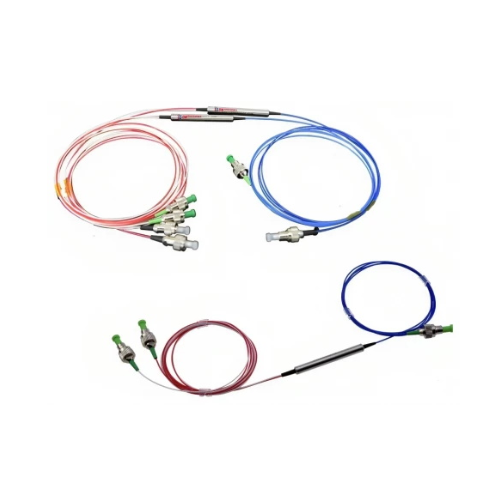
Imagine trying to merge two highways into one—without causing a single collision. In optical networks, engineers face this exact challenge every day: how to send and receive massive data streams through a single fiber without signals interfering with each other. The solution isn’t a complex active switch or a power-hungry router. It’s a palm-sized passive component called the fiber optic circulator.
This guide unpacks how this deceptively simple device uses the physics of light polarization to enforce one-way traffic rules for photons—and why getting its selection wrong can silently degrade your entire system.
The Physics Behind the “One-Way Street”
Non-Reciprocity: Breaking Symmetry with Magneto-Optics
Most optical components are reciprocal: light behaves the same way regardless of which direction it travels. A beam splitter doesn’t care if light enters from the left or the right. A circulator, however, is fundamentally non-reciprocal—it enforces a strict, sequential routing path.
In a standard 3-port configuration:
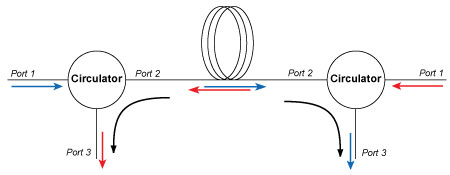
- Port 1 → Port 2 (transmit path)
- Port 2 → Port 3 (receive path)
- Port 3 → Port 1 (isolated, no reverse leakage)
This unidirectional behavior is achieved through Faraday rotation using magneto-optical crystals—typically yttrium iron garnet (YIG). An external magnetic field rotates the polarization plane of passing light by precisely 45°. A pair of polarization beam splitters (PBS) and a Faraday rotator work in tandem: light traveling in the “correct” direction passes through with minimal loss, while light attempting to backtrack experiences polarization misalignment and is dumped into an absorber or rejected entirely.
Engineering Insight: The quality of the YIG crystal and the stability of the permanent magnet directly determine your isolation specification. A 5°C shift in magnet temperature can degrade isolation by 3–5 dB in poorly designed units.
Two Flavors, Two Philosophies
Not all circulators are created equal. The polarization handling strategy defines their application domain:
| Feature | Polarization-Insensitive (PI) | Polarization-Maintaining (PM) |
|---|---|---|
| Input Tolerance | Accepts any polarization state | Requires aligned polarization |
| Typical IL | ≤ 0.6 dB | ≤ 0.8 dB |
| Isolation | ≥ 50 dB | ≥ 50 dB |
| Best For | WDM networks, OTDR, general telecom | Coherent detection, high-power lasers, interferometric sensors |
| Cost | $115–$300 | $400–$1,200+ |
PI Circulators are the workhorses of telecom. In long-haul links where polarization mode dispersion (PMD) randomizes the state of polarization (SOP) unpredictably, PI designs ensure consistent performance without active polarization control.
PM Circulators are the precision instruments. In coherent communication systems using QPSK or QAM modulation, the receiver’s local oscillator must maintain a stable phase relationship with the incoming signal. A PM circulator preserves the signal’s alignment to the fiber’s slow axis (or fast axis), preventing polarization-dependent loss (PDL) from eroding your OSNR.
Where Circulators Earn Their Keep
1. Bidirectional Transmission: Halving Your Fiber Plant
In FTTH (Fiber-to-the-Home) and 5G fronthaul networks, deploying separate fibers for upstream and downstream is economically unsustainable. A 3-port circulator enables single-fiber bidirectional (BiDi) operation:
- Downstream (OLT → ONU): 1490 nm or 1577 nm routed Port 1 → Port 2
- Upstream (ONU → OLT): 1310 nm or 1270 nm enters Port 2, exits Port 3 to the receiver
This architecture reduces fiber count by 50% and eliminates the need for additional splice points. In a 10,000-subscriber PON deployment, that’s thousands of kilometers of fiber saved.
2. WDM Networks: The Silent Partner of OADMs
In ROADM (Reconfigurable Optical Add-Drop Multiplexer) nodes, circulators work alongside thin-film filters or arrayed waveguide gratings (AWGs) to extract specific wavelengths from a dense WDM comb. A circulator directs the incoming multi-wavelength signal to the filter; the “dropped” wavelength reflects back into Port 3, while the remaining channels continue through. This reflective add-drop architecture is simpler and more compact than circulator-free alternatives.
3. Dispersion Compensation: Keeping Pulses Sharp
Chromatic dispersion broadens optical pulses at ~17 ps/(nm·km) in standard single-mode fiber (SSMF). For a 10 Gbps NRZ signal at 1550 nm, dispersion becomes a hard limit after ~60 km. DCMs (Dispersion Compensation Modules) using DCF (dispersion-compensating fiber) with negative dispersion slope are inserted inline. The circulator’s job is elegant but critical: route the signal into the DCF loop and back out, ensuring the compensating fiber doesn’t create a physical dead-end in the network topology.
4. Fiber Sensing: Separating Probe from Response
In OTDR (Optical Time-Domain Reflectometer) testing, a laser pulse is launched into the fiber under test (FUT). Rayleigh backscatter and Fresnel reflections return nanoseconds to milliseconds later, carrying distance-to-fault information. Without a circulator, this weak return signal (~-60 dBm) would collide with the high-power probe pulse (~0 dBm) at the laser source, making detection impossible. The circulator diverts the backscatter to a dedicated detector (Port 3), providing >50 dB of source-to-detector isolation.
In distributed acoustic sensing (DAS) and distributed temperature sensing (DTS), circulators handle the same separation task over tens of kilometers, enabling real-time pipeline monitoring and power cable hotspot detection.
5. High-Power Laser Systems: Protecting Your Investment
Industrial fiber lasers operating at 1064 nm or 1550 nm can deliver 1 kW–10 kW continuous-wave power. Even 0.1% back-reflection from a poorly aligned workpiece creates a 1 W–10 W return beam capable of destroying pump diodes or seed lasers. High-power circulators rated for 5 W, 10 W, or even 50 W forward power with high extinction ratios are the first line of defense.
In bidirectionally pumped EDFAs (Erbium-Doped Fiber Amplifiers), circulators separate the 980 nm or 1480 nm pump light from the amplified 1550 nm signal, preventing pump lasers from seeing amplified spontaneous emission (ASE) that would destabilize their operation.
Selection Criteria: A Systematic Approach
Choosing the wrong circulator doesn’t cause immediate failure—it causes gradual, hard-to-diagnose performance erosion. Use this framework:
Step 1: Define Your Port Topology
| Configuration | Use Case | Routing Logic |
|---|---|---|
| 3-Port | BiDi links, OTDR, simple sensors | 1→2→3→1 |
| 4-Port | Multi-channel sensing, amplifier chains, redundant paths | 1→2→3→4→1 |
Pro Tip: If your system might expand later, specify a 4-port circulator even if you only need 3 ports today. The unused port provides a test access point or future upgrade path at marginal additional cost.
Step 2: Match Wavelength Bands Precisely
- O-band (1260–1360 nm): Legacy short-haul, some PON upstream
- C-band (1530–1565 nm): Long-haul DWDM, lowest fiber attenuation (~0.20 dB/km)
- L-band (1565–1625 nm): Extended DWDM capacity
- S+C+L (1460–1625 nm): Wideband ROADM nodes
- 1064 nm: Nd:YAG and fiber laser systems, LIDAR
Critical: Specify center wavelength tolerance. A circulator tuned for 1550 nm ±10 nm will underperform if your actual carrier drifts to 1565 nm under temperature stress.
Step 3: Quantify Your Power Budget
Calculate your total link loss including:
- Circulator insertion loss (×2 if used bidirectionally): ~1.0–1.6 dB
- Connector losses: 0.3 dB per pair
- Fiber attenuation: 0.2 dB/km at 1550 nm
If your receiver sensitivity is -28 dBm and your transmitter outputs +3 dBm, your power margin is 31 dB. A poorly specified circulator with 1.5 dB IL instead of 0.6 dB consumes 30% of your entire budget on a single component.
Step 4: Environmental Hardening
For outdoor telecom shelters or oil/gas sensing deployments, verify:
- Operating temperature: -40°C to +85°C (industrial grade) or -5°C to +70°C (commercial)
- Storage temperature: -40°C to +85°C
- Vibration: IEC 61300-2-1 compliance for field reliability
- Humidity: 95% RH non-condensing
Failure Mode to Avoid: Standard epoxy-based assemblies soften above 75°C. For high-temperature borehole sensing (>150°C), specify hermetically sealed, epoxy-free packages with metal-to-glass fiber feedthroughs.
Step 5: Connector and Packaging Integration
| Connector | Best For | Caveat |
|---|---|---|
| LC/UPC | High-density data centers | Low reflectance (-55 dB), but physical contact requires cleanliness |
| SC/APC | FTTH, analog CATV | 8° angled polish eliminates back-reflection; essential for analog signals |
| FC/APC | Lab environments, sensors | Rugged threaded coupling; preferred for vibration-prone installs |
| Bare Fiber | Splicing into OEM modules | Lowest loss, but requires pigtail splicing expertise |
Common Pitfalls (And How to Avoid Them)
- Ignoring PDL in PM Systems: A PM circulator with >0.2 dB PDL will destroy the extinction ratio of your PM fiber link. Always specify PDL < 0.05 dB for coherent systems.
- Underspecifying Isolation: In high-channel-count DWDM systems, inadequate isolation creates ghost channels. Specify ≥55 dB for 100 GHz-spaced systems.
- Thermal Mismatch: Using a commercial-grade circulator (-5°C to +70°C) in an uncontrolled outdoor cabinet leads to wavelength drift and IL spikes. The cost difference between commercial and industrial grade is typically <$50—pay it.
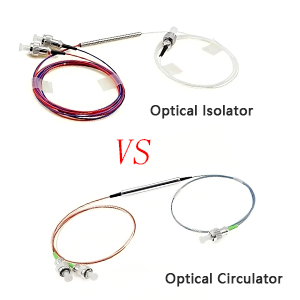
- Directional Confusion: Circulators are not isolators. An isolator blocks back-reflection to protect a single source. A circulator routes signals between multiple ports. Using a circulator as an isolator wastes ports and increases unnecessary loss.
The Bottom Line
The fiber optic circulator is easy to overlook precisely because it works so reliably. Buried inside amplifier nodes, sensing interrogators, and laser systems, it enforces the optical equivalent of traffic laws—silently, passively, and without complaint. But as networks push toward 800G coherent transmission, LIDAR demands sub-nanosecond precision, and industrial lasers reach multi-kilowatt outputs, the circulator’s specifications are no longer “good enough” margins. They are hard system boundaries.
Understanding its physics, respecting its selection criteria, and integrating it thoughtfully into your link budget isn’t just best practice—it’s the difference between a network that performs at specification and one that mysteriously underperforms for years.
Need a circulator tailored to your wavelength, power level, or environmental constraints? Fiber-Life provide custom configurations—including S+C+L wideband models, high-power PM variants, and hermetically sealed packages—ensure your component isn’t the weakest link in your optical chain.