FREE SHIPPING On Orders Over US$200
Optical circulators and optical isolators are both passive, non-reciprocal fiber optic components, but they perform different jobs. A circulator routes light between multiple ports, while an isolator allows light to travel primarily in one direction and attenuates backward reflections.
Understanding this distinction helps engineers choose the right component for fiber communication, sensing, testing, amplification, and laser systems.
1. Optical Circulator vs Isolator: Quick Comparison
| Feature | Optical Circulator | Optical Isolator |
|---|---|---|
| Primary function | Routes light between multiple ports | Reduces backward-propagating light |
| Typical configuration | 3-port or 4-port | 2-port |
| Signal path | Port 1 → Port 2, Port 2 → Port 3 | Forward transmission with reverse attenuation |
| Reflected signal | Directed to another port | Strongly attenuated |
| Common applications | Bidirectional links, FBG systems, sensing and testing | Laser protection, amplifiers and measurement systems |
| Can the returned signal be used? | Yes, through another port | Normally no |
| Main selection considerations | Port configuration, insertion loss, isolation and crosstalk | Insertion loss, isolation and return loss |
The simplest way to distinguish them is to consider what should happen to returning light:
- Choose an optical circulator when the returned signal must be routed, measured or processed.
- Choose an optical isolator when the returned signal is unwanted and should be attenuated.
2. How Do Optical Circulators and Isolators Work?
Many conventional optical circulators and isolators use magneto-optic effects to produce non-reciprocal transmission. However, their optical paths and intended functions are different.
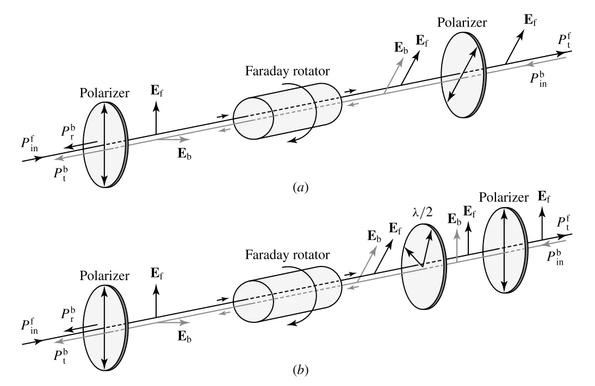
Optical circulator signal path
A typical three-port optical circulator routes light sequentially:
- Light entering Port 1 exits through Port 2.
- Light returning through Port 2 is directed to Port 3.
- In designs supporting the complete circulation path, light entering Port 3 is directed to Port 1.
This routing allows forward and returning signals to use the same fiber without arriving at the same equipment port.
Port arrangements can differ between models, so the specified transmission direction should always be confirmed on the product datasheet.
Optical isolator signal path
An optical isolator normally has an input and an output. It provides relatively low loss in the forward direction while strongly attenuating light traveling in reverse.
The reverse signal is not necessarily eliminated completely. Its attenuation is defined by the isolator’s isolation rating. This makes the isolator useful when reflections could destabilize a laser, increase noise or interfere with an optical measurement.
3. Key Differences Between an Optical Circulator and Isolator
Although both components control the direction of light, they are not interchangeable.
3.1 Routing versus protection
An optical circulator redirects light to a different port. An optical isolator suppresses light that returns toward the source.
For example, if a reflected signal contains useful measurement data, a circulator can direct it to a receiver. If the reflection only creates interference, an isolator is generally the more direct solution.
3.2 Number of ports
Circulators commonly have three or four ports because they must provide separate paths for multiple signals. Isolators commonly use a two-port input-to-output configuration.
3.3 Treatment of reflected light
A circulator preserves and redirects the returning signal, subject to the component’s insertion loss and isolation performance. An isolator attenuates the returning signal instead of providing a separate output for it.
3.4 System design
A circulator becomes part of the signal-routing architecture. An isolator is normally installed to improve source stability or protect a sensitive optical stage from feedback.
4. When Should You Use an Optical Circulator?
An optical circulator is appropriate when signals traveling in opposite directions must be separated or when reflected light needs to be collected.
Bidirectional transmission over one fiber
An optical circulator can separate transmitted and received signals in certain single-fiber bidirectional systems. This can reduce the number of fibers required, although the complete design must still account for operating wavelength, transmission format and link loss.
Fiber Bragg grating systems
A fiber Bragg grating reflects selected wavelengths while transmitting others. A circulator can send light toward the grating and direct the reflected wavelength from another port to a detector.
This configuration is commonly used in fiber sensing, filtering and wavelength-selective optical systems.
Optical testing and monitoring
In test systems, a circulator can separate the launched signal from the returned signal. This allows reflected or backscattered light to reach measurement equipment without sharing the source port.
Fiber laser and amplifier systems
Circulators may be used to manage signal paths in fiber laser, amplifier and experimental optical assemblies. However, the circulator must be selected for the correct wavelength, optical power, fiber type and polarization requirements.
For example, a 1064 nm high-power polarization-insensitive optical circulator may be considered for compatible 1064 nm fiber laser, interferometer and measurement applications. Actual suitability should be confirmed from the product specifications and system power conditions.
5. When Should You Use an Optical Isolator?
An optical isolator is usually selected when backward light could negatively affect an optical source or another sensitive component.
Laser source protection
Reflections may return from connectors, splices, optical surfaces or downstream devices. An isolator helps reduce this feedback before it reaches the laser source.
This can improve operating stability, but it does not remove the need for clean connectors, correct termination and suitable return-loss control.
Optical amplifiers
Isolators may be placed around amplifier stages to limit unwanted backward propagation and reduce interaction between different parts of the optical system.
Precision measurement systems
Reflected light can introduce noise or measurement instability. An isolator helps separate the source from downstream reflections when the returned signal does not need to be collected.
High-power optical systems
High-power applications require more than checking the operating wavelength. The isolator must also meet the required average-power, peak-power, connector and thermal-handling specifications.
6. Specifications to Check Before Choosing
The component type alone does not determine whether it will work correctly. The following specifications should be checked against the complete optical system.
6.1 Operating wavelength
Select a component designed for the system wavelength, such as 1064 nm, 1310 nm or 1550 nm. A device optimized for one wavelength should not be assumed to deliver the same performance at another wavelength.
6.2 Insertion loss
Insertion loss is the optical power lost along the intended transmission path. Lower insertion loss helps preserve the system power budget.
For a circulator, check the loss for every required path, such as Port 1 to Port 2 and Port 2 to Port 3.
6.3 Isolation
Isolation describes how effectively unwanted light is prevented from traveling into an undesired port or reverse direction. A higher isolation value generally indicates stronger suppression, but it should always be evaluated together with insertion loss and the application’s feedback sensitivity.
6.4 Return loss
Return loss indicates how much light is reflected back toward the source. When return loss is expressed as a positive decibel value, a higher value represents lower reflection.
6.5 Optical power
Confirm both average and peak optical power where applicable. High-power laser systems may require specialized fiber, packaging, connectors or connector-free pigtails.
Do not select a component based only on a general “high-power” description. The required rating should be verified under the actual operating conditions.
6.6 Fiber and polarization type
Depending on the system, available options may include:
- Single-mode fiber
- Polarization-maintaining fiber
- Polarization-insensitive designs
- Specific fiber types for high-power or wavelength-dependent applications
A polarization-maintaining component is important when the state of polarization must be preserved. A polarization-insensitive component may be more appropriate when input polarization varies.
6.7 Connector and package configuration
Common connector choices include FC/UPC, FC/APC, SC/UPC and SC/APC. UPC and APC connectors should not be directly mated because their end-face geometries are different.
For high-power or laboratory systems, bare fiber, a special package or a customized pigtail may be preferable to a standard connectorized configuration.
7. How to Choose the Right Component
Use the following decision process before placing an order:
- Determine the purpose of the returning light.
If it must be detected or reused, consider a circulator. If it is unwanted feedback, consider an isolator. - Confirm the required optical path.
For a circulator, identify which port-to-port paths the system requires. - Match the operating wavelength.
The component must be specified for the source wavelength and required bandwidth. - Calculate the loss budget.
Include the component’s insertion loss together with connector, splice and fiber losses. - Check isolation and return-loss requirements.
Systems with reflection-sensitive lasers may require higher isolation and careful connector selection. - Verify power and polarization conditions.
Confirm average power, peak power, fiber type and polarization requirements. - Select the connector or pigtail format.
Make sure the connector polish and fiber interface match the rest of the system.
Fiber-Life offers a range of passive optical components for different wavelengths, fiber types, connector options and optical system requirements.
8. Frequently Asked Questions
Can an optical circulator replace an optical isolator?
Not automatically. A circulator can route reflected light away from the input path, but it is primarily a routing component. An isolator is specifically designed to attenuate backward light.
If a circulator is considered for feedback management, the unused or monitoring port must be handled correctly, and its isolation and power specifications must meet the system requirements.
Is an optical circulator bidirectional?
A circulator supports directional transmission between designated ports, but it is not bidirectional in the same way as a standard fiber coupler. Light follows a defined sequence rather than freely traveling back and forth between the same two ports.
Which component is better for a fiber laser?
It depends on the system function. An isolator is typically used to reduce optical feedback into the laser. A circulator is selected when a signal needs to be routed between the laser, another optical device and a receiver or monitoring port.
Which component is suitable for an FBG sensor?
An optical circulator is commonly used when light must be sent toward the FBG and the reflected wavelength must be directed to a detector. The wavelength, insertion loss, isolation, power and fiber type must still match the sensing system.
Conclusion
Optical circulators and isolators solve different optical-system problems. A circulator routes forward and returning signals through separate ports, while an isolator attenuates unwanted light traveling back toward the source.
Choose according to what the system must do with reflected light, then verify the wavelength, insertion loss, isolation, return loss, power rating, fiber type and connector configuration. This approach produces a more reliable result than selecting either component by name alone.