FREE SHIPPING On Orders Over US$200

A fiber optic stripper removes protective material so a fiber can be prepared for splicing or termination. However, removing a cable jacket is a different task from stripping the thin coating around the glass.
The right choice depends on what you need to remove, what must remain underneath and the cable construction. Start with those details before comparing tool designs.
1. Start with the Layer You Need to Remove
Product descriptions often use “jacket,” “buffer” and “coating” together, but these terms refer to different protective layers.
- Outer jacket: The cable’s external covering. Removing it exposes internal components, which may include strength members, buffered fibers or tubes.
- Tight buffer: An additional protective layer around an already coated fiber, commonly used in indoor cable constructions.
- Primary coating: The polymer coating surrounding the glass fiber. This is removed when preparing bare glass for fusion splicing.
Not every cable has all three layers. A loose-tube cable, for example, requires a different preparation process from a tight-buffered cord.
A fiber optic cable stripper also does a different job from a cleaver. Stripping removes protective material; cleaving prepares the glass end face after stripping and cleaning.
2. Read the Dimensions Before Choosing a Tool
Once you have identified the layer, check both its outside diameter and the diameter that should remain after stripping.
For example, a tool that removes a 900 µm tight buffer while preserving the 250 µm coated fiber performs a different operation from one that removes the coating to expose 125 µm glass.
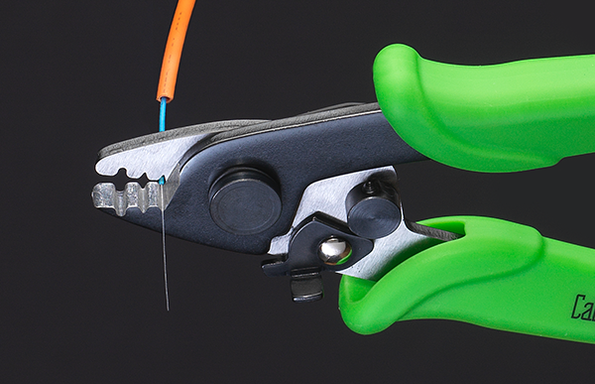
These numbers describe outside diameters—not coating thickness or optical core size.
| Preparation task | Common example | Selection priority |
|---|---|---|
| Remove a cord jacket | A 2–3 mm jacket | Jacket size, material and cord construction |
| Remove a tight buffer | 900 µm down to 250 µm coated fiber | Preserving the underlying coating |
| Remove the primary coating | 250 µm down to 125 µm glass | Compatibility with the coating and glass diameter |
| Strip ribbon fiber | Multiple fibers prepared together | Ribbon construction, fiber count and compatible holders |
The table shows common examples rather than universal dimensions. Specialty fibers and smaller coatings may need different tools.
Do not choose a stripper solely because the fiber is single-mode or multimode. The protective layers and their dimensions are more useful selection criteria.
3. Decide Whether a Manual Stripper Fits the Job
Manual strippers are a practical option for many individual-fiber preparation tasks. Multi-hole designs provide separate openings for removing different layers.
For instance, the Miller CFS-3 Three-Hole Fiber Optic Stripper provides separate stripping openings for jackets, tight buffers and primary coatings. The correct opening depends on the material being removed and the layer that must remain.
The Fujikura SS05 Fiber Optic Stripper is another manual option. Compare its specified stripping positions with your fiber or cord dimensions before selecting it.
More openings do not automatically mean a better tool. What matters is whether the available positions match your work.
A multi-hole stripper should not be treated as a complete cable-opening kit. Armor, strength members and loose tubes may require dedicated tools.
4. Consider Thermal Stripping When Needed
Thermal strippers use heat to soften compatible coating material before removal. Depending on the model, they may support individual fibers, ribbon fibers or both.
Consider this option when the preparation procedure calls for thermal stripping or when a compatible ribbon stripper suits the fibers you need to prepare together.
Check the following before choosing a model:
- Fiber compatibility: Coating material, diameter and supported ribbon construction.
- Holder requirements: Whether the required holders are included and suitable for your fiber.
- Stripping length: Whether the supported length fits the next preparation step.
- Operating requirements: Heating settings, power supply and maintenance.
A thermal stripper does not automatically replace a jacket stripper. Its suitability depends on the specific layer and material it is designed to remove.
5. Check Practical Details Before Ordering
With the tool type selected, consider how it will fit your daily work.
Required preparation length: Follow the requirements of the connector, fiber holder or splicing procedure. Removing extra coating unnecessarily leaves more glass exposed to handling damage.
Maintenance: Check whether the tool uses factory-set openings, adjustable parts or replaceable blades. Follow the manufacturer’s maintenance instructions rather than assuming the blades can be adjusted.
Handling: For repeated use, consider grip comfort, access to the stripping openings and how the fiber is supported during preparation.
During operation, unusual resistance, repeated breakage or persistent residue are reasons to stop and check the tool, fiber compatibility and technique. Pulling harder is not a reliable solution.
Wear appropriate eye protection, collect any glass fragments in a suitable container and avoid touching exposed fiber. Complete the specified cleaning process before cleaving.
Conclusion
Choose a fiber optic stripper by matching the protective layer, its dimensions and the required preparation method. A compatible manual tool may cover several tasks, while thermal stripping is appropriate for specific coating and ribbon requirements.
Browse Fiber-Life’s Fiber Cable Strippers to compare options against your fiber specifications and working requirements.