FREE SHIPPING On Orders Over US$200
As data centers move toward higher transmission speeds, network designers must decide whether their existing multimode cabling can support future upgrades or whether a newer fiber category is required.
OM5 fiber was introduced as a wideband multimode fiber designed to support multiple short wavelengths over one fiber. This makes it particularly relevant to Shortwave Wavelength Division Multiplexing, or SWDM, which can transmit several optical channels through a conventional duplex fiber connection.
However, OM5 is not automatically faster than OM4 in every application. For many conventional 850 nm Ethernet links, OM5 and OM4 support the same standardized transmission distance. OM5 provides its clearest advantage when paired with compatible wideband optical transceivers.
This guide explains how OM5 differs from OM3 and OM4, how SWDM works, which optical modules are compatible and when OM5 is a practical choice.
What Is OM5 Multimode Fiber?

OM5 is a laser-optimized, 50/125 μm wideband multimode fiber. It was developed to support optical transmission across a wider short-wavelength range than traditional OM3 and OM4 fiber.
The Telecommunications Industry Association published the TIA-492AAAE specification for wideband multimode fiber in 2016. OM5 was subsequently recognized as a multimode fiber category in international cabling standards.
Like OM3 and OM4, OM5 has:
- A 50 μm core diameter
- A 125 μm cladding diameter
- Support for VCSEL-based multimode transmission
- Compatibility with common LC and MPO connectivity
- Support for conventional 850 nm multimode applications
Its main difference is that its modal bandwidth is controlled across a wider wavelength range, enabling more predictable performance for SWDM transmission.
OM5 cables are commonly identified by a lime-green outer jacket, although connector and jacket colors should not be used as the only method of confirming fiber specifications.
OM3 vs. OM4 vs. OM5: Key Specifications
The most important difference between OM5 and earlier laser-optimized multimode fibers is the wavelength range over which bandwidth performance is specified.
| Specification | OM3 | OM4 | OM5 |
|---|---|---|---|
| Core/cladding diameter | 50/125 μm | 50/125 μm | 50/125 μm |
| Minimum EMB at 850 nm | 2,000 MHz·km | 4,700 MHz·km | 4,700 MHz·km |
| Minimum EMB at 953 nm | Not specified | Not specified | 2,470 MHz·km |
| Primary operating concept | 850 nm transmission | Higher-bandwidth 850 nm transmission | Wideband 850–953 nm transmission |
| Typical jacket color | Aqua | Aqua or violet | Lime green |
| SWDM optimization | No | Not specifically standardized | Yes |
OM5 provides the same minimum effective modal bandwidth as OM4 at 850 nm. Its additional specification at 953 nm is what distinguishes it as wideband multimode fiber.
Therefore, OM5 should not be described simply as a higher-bandwidth replacement for OM4. At 850 nm, their specified EMB is the same. OM5’s additional value appears when several wavelengths are transmitted between approximately 850 and 950 nm.
What Is Effective Modal Bandwidth?
Effective Modal Bandwidth, or EMB, describes the ability of a multimode fiber to carry high-speed signals while accounting for the interaction between the fiber’s modal characteristics and the launch profile of a laser source.
It is normally expressed in MHz·km.
A higher EMB generally allows a high-speed signal to travel farther before modal dispersion causes unacceptable pulse spreading. However, transmission distance is not determined by EMB alone.
Other factors include:
- Transceiver design
- Modulation format
- Optical wavelength
- Fiber attenuation
- Connector and splice loss
- Chromatic dispersion
- Receiver sensitivity
- Forward error correction
- Overall channel-loss budget
This is why a fiber category alone cannot determine the maximum distance of every optical link.
What Is SWDM?
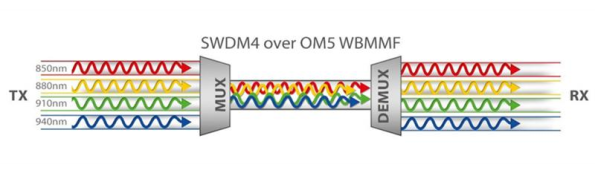
SWDM stands for Shortwave Wavelength Division Multiplexing.
Instead of transmitting one optical channel over each fiber, SWDM combines several short-wavelength optical channels onto the same fiber. At the receiving end, the wavelengths are separated and converted back into individual electrical data lanes.
A typical SWDM4 system uses four wavelengths centered around:
- 850 nm
- 880 nm
- 910 nm
- 940 nm
One fiber carries the transmit wavelengths and the second fiber carries the receive wavelengths. The connection therefore uses a conventional duplex multimode fiber pair.
For example:
- A 40G SWDM4 transceiver carries four 10G optical lanes.
- A 100G SWDM4 transceiver carries four 25G optical lanes.
This allows 40G or 100G transmission over two fibers instead of the eight active fibers commonly used by parallel-optics SR4 systems.
Does OM5 Reduce the Required Fiber Count?
OM5 can reduce fiber count when it is used with compatible SWDM transceivers.
A conventional 40GBASE-SR4 or 100GBASE-SR4 parallel-optics link normally uses:
- Four transmit fibers
- Four receive fibers
- Eight active fibers in total
An SWDM4 link multiplexes four wavelengths onto each transmission direction and therefore operates over:
- One transmit fiber
- One receive fiber
- Two fibers in total
This represents a four-to-one reduction in active fiber count compared with an eight-fiber parallel-optics link.
However, the reduction comes from the SWDM optical architecture, not from OM5 fiber alone. Installing OM5 cable does not automatically convert an eight-fiber SR4 system into a two-fiber system. Compatible SWDM transceivers must be installed at both ends.
What Transmission Distance Does OM5 Support?
The maximum transmission distance depends on the optical module and transmission standard.
For conventional IEEE 850 nm applications, OM5 generally provides the same specified reach as OM4 because both have a minimum EMB of 4,700 MHz·km at 850 nm.
For SWDM4 applications, OM5 can provide additional distance because its performance is specified across the extended short-wavelength range.
SWDM4 Transmission Distances
| Application | OM3 | OM4 | OM5 |
| 40G SWDM4 | 240 m | 350 m | 440 m |
| 100G SWDM4 | 75 m | 100 m | 150 m |
The 100G SWDM4 MSA specifies four optical lanes centered at 850, 880, 910 and 940 nm, with maximum operating distances of 75 m over OM3, 100 m over OM4 and 150 m over OM5.
These values apply to compatible SWDM4 modules and compliant channels. They should not be used as universal distance specifications for all 40G or 100G transceivers.
Is OM5 Always Better Than OM4?
No. OM5 is technically more capable across the wider 850–953 nm wavelength range, but that does not mean it provides a practical benefit in every network.
OM5 and OM4 Perform Similarly When:
- The transceiver operates only around 850 nm.
- The application follows a conventional IEEE SR standard.
- The specified link distance is already supported by OM4.
- The network uses parallel MPO-based transmission.
- There is no plan to deploy SWDM or another wideband technology.
In these cases, installing OM5 may not increase the supported transmission speed or distance.
OM5 Provides a Clearer Advantage When:
- SWDM4 transceivers are being deployed.
- A duplex LC cabling infrastructure must support higher data rates.
- Reducing the number of fibers is a design priority.
- Additional SWDM transmission distance is required.
- The organization wants wideband multimode performance specified beyond 850 nm.
The decision should therefore be based on the transceiver roadmap and cabling architecture rather than on the assumption that a higher OM category is always better.
Is OM5 Backward Compatible with OM3 and OM4?

OM5 uses the same 50/125 μm geometry as OM3 and OM4 and meets the OM4 bandwidth requirement at 850 nm. Conventional multimode connectors and 850 nm optical interfaces can therefore generally operate over OM5 fiber.
For example, an 850 nm transceiver designed for OM3 or OM4 can normally transmit over a properly constructed OM5 channel, subject to the transceiver’s specified reach and link-loss budget.
However, several points must be understood:
- OM5 does not improve the performance rating of the transceiver.
A module specified for a particular distance remains subject to that specification. - The weakest section determines the channel capability.
A channel containing OM3, OM4 and OM5 components cannot automatically be treated as a complete OM5 channel. - SWDM advantages require SWDM modules.
A standard 850 nm transceiver does not use the additional wideband characteristics of OM5. - Connector cleanliness and loss still matter.
Fiber-category compatibility does not eliminate insertion-loss, contamination or polarity requirements.
For new installations, using one consistent fiber category throughout the channel makes documentation, testing and future maintenance easier.
Are Existing Optical Modules Compatible with OM5?
In most cases, standard 850 nm multimode modules that support OM3 or OM4 can also operate over OM5 because OM5 satisfies the relevant 850 nm OM4 bandwidth requirement.
Examples may include compatible versions of:
- 10GBASE-SR
- 40GBASE-SR4
- 100GBASE-SR4
- Other 850 nm multimode optical interfaces
However, the maximum reach will normally remain the reach specified for that optical module. A conventional SR4 transceiver does not automatically gain the longer SWDM distance merely because it is connected to OM5 fiber.
OM5’s distinctive wideband capability is used by optical modules designed to transmit multiple short wavelengths, such as SWDM4 modules.
The module datasheet should always be checked for:
- Supported fiber categories
- Maximum link distance
- Connector interface
- Required fiber count
- Wavelengths
- Forward error correction requirements
- Maximum channel insertion loss
Does OM5 Support 400G and Higher Speeds?
OM5 can be used in certain high-speed multimode systems, but the term “400G” does not identify one universal optical interface.
Different 400G transceivers may use:
- Duplex multimode fiber
- Eight-fiber parallel transmission
- Sixteen-fiber parallel transmission
- Duplex single-mode fiber
- Multiple wavelengths
- Different connector formats
Some 400G multimode applications can operate over OM5, but they may not receive any additional benefit compared with OM4 unless their optical design uses OM5’s wideband characteristics.
Higher speed alone does not create a requirement for OM5. The correct fiber must be selected according to the specific transceiver standard and its published cabling requirements.
As of 2026, IEEE work on future 200 Gb/s-per-wavelength multimode PHYs continues to evaluate reach over OM3, OM4 and OM5. This reinforces the importance of checking the final module and standard specifications rather than relying only on the nominal Ethernet speed.
Is OM5 Cabling Less Expensive Than OM4?
OM5 cable is generally priced higher than comparable OM4 cable. It is therefore inaccurate to state that OM5 cabling is automatically half the cost of OM4.
OM5 may lower the total installed cost in a specific SWDM architecture when it enables:
- Fewer installed fibers
- Continued use of duplex LC connectivity
- Reduced pathway congestion
- Fewer MPO trunks or breakout components
- Reuse of an existing duplex cabling system
- Longer SWDM transmission distances
However, total cost also depends on:
- OM5 cable price
- SWDM transceiver availability and price
- Patch-panel and connector requirements
- Installation labor
- Required transmission distance
- Upgrade strategy
- Spare-component availability
- Expected service life
A proper comparison should evaluate the complete link rather than only the price per meter of fiber.
OM5 vs. Single-Mode Fiber
OM5 and single-mode fiber are designed for different network requirements.
| Factor | OM5 Multimode Fiber | OS2 Single-Mode Fiber |
| Core diameter | 50 μm | Approximately 9 μm |
| Typical applications | Short-reach data center links | Short-, medium- and long-reach links |
| Common light source | VCSEL | Laser |
| Typical wavelengths | Approximately 850–953 nm | Commonly 1310 or 1550 nm |
| Connector options | LC and MPO | LC, SC, MPO and others |
| Distance capability | Application-dependent, generally shorter | Significantly longer |
| SWDM support | Yes | Uses other WDM technologies |
| Optics cost | Often economical for short-reach systems | Varies by reach and module type |
The choice should not be based on a fixed 500 m dividing line.
A more reliable decision process considers:
- Required data rate
- Current and future link distance
- Switch and transceiver availability
- Port density
- Power consumption
- Cable pathway capacity
- Installation environment
- Expected upgrade cycle
- Total cost of ownership
Multimode fiber is often attractive for short-reach data center links using cost-effective VCSEL optics. Single-mode fiber offers much greater reach and a broad selection of high-speed optical technologies.
For a new facility, the transceiver roadmap should be evaluated before deciding between OM4, OM5 and OS2.
When Should You Choose OM5?
OM5 is worth considering when most of the following conditions apply:
- The network will use SWDM-compatible transceivers.
- Duplex LC connectivity is preferred over parallel MPO connectivity.
- Fiber-pathway capacity is limited.
- The additional SWDM reach over OM4 is required.
- The cost premium is acceptable.
- Wideband multimode performance is part of the upgrade strategy.
- The expected optical-module roadmap supports OM5.
OM4 may be the more economical option when:
- The network uses conventional 850 nm SR transceivers.
- Existing OM4 distances are sufficient.
- Parallel MPO cabling is already installed.
- SWDM deployment is not planned.
- The additional OM5 cable cost provides no measurable operational benefit.
OS2 may be more suitable when:
- Longer transmission distance is required.
- The network has a long service-life expectation.
- High-speed single-mode optics are part of the equipment roadmap.
- Maximum architectural flexibility is more important than short-reach optics cost.
Common Misconceptions About OM5
Misconception 1: OM5 Is Faster Than OM4 in Every Application
OM5 and OM4 have the same minimum EMB at 850 nm. OM5’s main advantage is its specified wideband performance up to 953 nm.
Misconception 2: OM5 Is Required for 100G or 400G
Many 100G and 400G optical standards operate over OM4 or single-mode fiber. Fiber requirements depend on the specific transceiver, not only on the Ethernet speed.
Misconception 3: Installing OM5 Automatically Reduces Fiber Count
Fiber-count reduction requires compatible duplex SWDM optics. The cable alone does not change the optical lane architecture.
Misconception 4: Standard Multimode Modules Cannot Use OM5
Most conventional 850 nm modules that support OM4 can also operate over OM5, subject to the module specifications and link-loss budget.
Misconception 5: OM5 Is Always More Cost-Effective
OM5 usually carries a cable-price premium. Its economic value depends on whether the network can benefit from SWDM, lower fiber count or extended wideband reach.
Frequently Asked Questions
What is the main difference between OM4 and OM5?
Both provide a minimum EMB of 4,700 MHz·km at 850 nm. OM5 additionally specifies a minimum EMB of 2,470 MHz·km at 953 nm, making it suitable for wideband SWDM transmission.
Can OM5 be connected to OM4 equipment?
Generally, yes. OM5 uses the same 50/125 μm geometry and supports conventional 850 nm multimode applications. The complete channel should still meet the transceiver’s fiber and loss requirements.
Does OM5 require special connectors?
No special connector format is required solely because the fiber is OM5. Common LC and MPO connectors can be used, provided the assembly is manufactured and tested for the intended application.
Can OM5 use LC duplex connections?
Yes. One of its principal applications is SWDM transmission over a two-fiber LC duplex connection.
Is OM5 required for SWDM?
SWDM modules may also operate over OM3 and OM4, but OM5 is specifically standardized for wideband performance and can support longer specified SWDM distances.
Is OM5 suitable for existing 10G networks?
Yes, but it may provide little practical advantage over OM4 for a conventional 850 nm 10G link. The decision depends on future upgrade plans.
Conclusion
OM5 is a wideband multimode fiber developed to support multiple short wavelengths between approximately 850 and 950 nm. Its defining characteristic is not a higher 850 nm bandwidth than OM4, but the addition of controlled modal-bandwidth performance at 953 nm.
This makes OM5 particularly valuable for SWDM applications, where four optical wavelengths can be transmitted over a duplex fiber pair. In supported configurations, SWDM can reduce fiber count and provide greater transmission distance over OM5 than over OM3 or OM4.
Nevertheless, OM5 is not the default choice for every high-speed data center. Conventional 850 nm Ethernet applications may achieve the same standardized distance over OM4, while many longer-reach and next-generation links are better served by single-mode fiber.
The correct decision should be based on the required transceiver, transmission distance, connector architecture, link-loss budget and total installed cost.
Fiber-Life supplies customizable OM3, OM4 and OM5 multimode fiber assemblies, including LC patch cables, MPO cable assemblies, pigtails and high-density data center cabling solutions. Fiber type, connector format, polarity, jacket material, cable length and test requirements can be configured for specific network applications.