FREE SHIPPING On Orders Over US$200
Why Your Next PON Upgrade Might Not Require a Single Truck Roll
It is 2:00 AM. A telecom technician is splicing fiber in a cramped underground closure, working against a four-hour maintenance window. The mission: replace thirty-two 1:32 PLC splitters with 1:64 models because subscriber density has doubled in eighteen months. By 5:00 AM, the splicing is done, but three fibers test over budget. The window closes. Three households lose service for another week.
This scenario plays out thousands of times annually across global FTTH networks. The culprit is not labor shortage or poor planning. It is a fundamental architectural constraint: the optical splitter has been a passive, immutable device since its commercialization in the 1990s. Once the split ratio is etched into silica, it is locked forever.
That is now changing. Three converging innovations—non-volatile phase-change programming, sub-micron 3D photonic printing, and AI-driven precision coupling—are transforming the splitter from a passive rock into a reconfigurable node. The implications extend beyond convenience. They redefine the total cost of ownership (TCO) for optical access networks.
Part I: The Fixed-Ratio Trap—Why PON Networks Hit a Wall
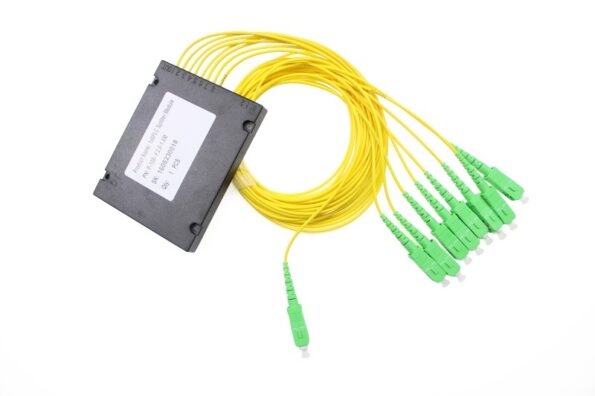
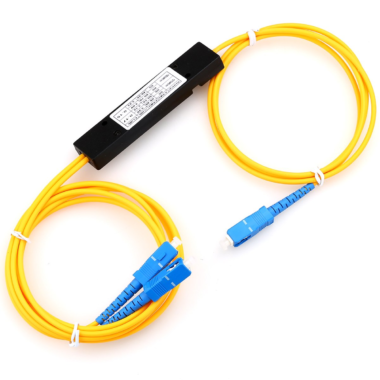
Planar Lightwave Circuit (PLC) splitters are marvels of miniaturization. A 1×64 device, smaller than a matchbox, divides an incoming optical signal into sixty-four equal-power outputs using cascaded Y-branch waveguides or Multi-Mode Interference (MMI) couplers fabricated on silica-on-silicon substrates. They are passive, reliable, and cheap—typically $15–$50 per unit in volume.
But their strength is also their prison. The split ratio is lithographically frozen at manufacture. When an operator needs to:
- Split a 1:32 leg into two 1:16 legs to serve a new apartment block
- Rebalance power after adding an amplifier or extending reach
- Migrate from GPON to XGS-PON (which requires higher per-port optical budget)
The only option is physical replacement. In a 10,000-subscriber PON, this means:
- Service downtime: 2–4 hours per splitter location
- Truck rolls: $200–$400 per dispatch
- Inventory complexity: Stocking 1:2, 1:4, 1:8, 1:16, 1:32, and 1:64 variants
- Stranded assets: Decommissioned splitters cannot be reprogrammed for other ratios
Thermally tunable splitters exist, but they require continuous electrical power (5–20 mW per device), integrated micro-heaters, and control circuitry. In a passive optical network, adding active components at every splitter node defeats the entire “passive” philosophy and introduces failure points where none existed.
The industry needed a splitter that is programmable, non-volatile, and compatible with existing PLC manufacturing. In 2025, a research team delivered exactly that.
Part II: The Sb₂S₃ Breakthrough—Programming Light with Phase Transitions
Why Sb₂S₃, Not GST?
Phase-change materials (PCMs) are not new. Ge₂Sb₂Te₅ (GST) has dominated optical discs and emerging photonic switches for decades. But GST has a fatal flaw for telecommunications: high absorption in the C-band (1530–1565 nm). Its extinction coefficient (k) in the crystalline state is too large for low-loss waveguide integration. A GST-coated PLC splitter would bleed away signal power, making it unsuitable for access networks where every decibel counts.
Antimony trisulfide (Sb₂S₃) changes the equation. This wide-bandgap chalcogenide exhibits:
- Amorphous state: Bandgap ~2.05 eV, refractive index n ≈ 2.7
- Crystalline state: Bandgap ~1.72 eV, refractive index n ≈ 3.3
The resulting refractive index contrast of Δn ≈ 0.6 is sufficient to induce large phase shifts in compact interferometric structures, while the material remains low-loss in the telecom window.
The Mach-Zehnder Architecture
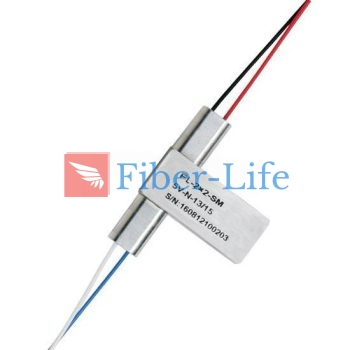
The breakthrough device is deceptively simple. A standard silica PLC Mach-Zehnder Interferometer (MZI)—two parallel waveguide arms with a directional coupler at each end—has a 500 nm Sb₂S₃ film sputtered onto one arm.
In its as-deposited amorphous state, the Sb₂S₃ layer has minimal impact on the guided mode. The MZI behaves like a standard 50:50 splitter. But when a focused laser (3–5 mW, scanned at 10–40 μm/s) traces a 1–6 mm line along the arm, the local temperature exceeds the crystallization threshold (>270°C). The material transitions to its crystalline phase, increasing the effective refractive index of that arm.
This introduces a controlled phase shift between the two interferometer arms, redirecting optical power between the output ports. The split ratio shifts from 50:50 to 80:20—or any intermediate state—depending on the crystallized length. Raman spectroscopy confirms the phase state via characteristic peaks at 189 cm⁻¹ and 290 cm⁻¹.
The Non-Volatile Advantage
Once crystallized, the Sb₂S₃ state is permanently locked at room temperature. No power is required to maintain it. The device draws energy only during the writing operation (<10 μJ per switch)—comparable to a single bit-flip in flash memory. This is the critical distinction from thermo-optic tunable splitters, which consume power continuously and reset on power loss.
| Attribute | Fixed PLC Splitter | Thermo-Optic Tunable | Sb₂S₃ PCM Programmable |
|---|---|---|---|
| Split ratio flexibility | None | Continuous | Discrete steps (multi-level) |
| Power consumption | 0 mW | 5–20 mW continuous | <10 μJ per write; 0 mW hold |
| Insertion loss | ~3.5 dB (1×16) | ~4.5 dB | ~1 dB additional over baseline |
| Retention | Permanent | Volatile | Permanent (non-volatile) |
| Manufacturing | Standard PLC | PLC + heaters + wiring | PLC + sputtering + laser write |
Manufacturing Compatibility
Perhaps the most commercially significant aspect is process integration. The Sb₂S₃ film is deposited by standard magnetron sputtering after the conventional PLC waveguide fabrication is complete. No additional lithography, etching, or cladding regrowth is required. An existing PLC foundry can add this capability with two steps: a sputtering chamber and a laser direct-writing station.
This matters because PLC splitters are commodity components manufactured at massive scale in Asia-Pacific foundries. A solution that requires rebuilding the fab is dead on arrival. A solution that adds two steps to existing lines is a product roadmap.
Part III: 3D-Printed Photonics—When Splitters Shrink to the Size of a Hair
While phase-change programming solves reconfigurability, another frontier is attacking size and customization. Enter two-photon polymerization (2PP)—a 3D printing technique that solidifies photoresist with femtosecond laser pulses at the diffraction limit.
Researchers at Vrije Universiteit Brussel (VUB) have demonstrated a monolithic 1×4 optical splitter for multi-core fiber (MCF) systems, fabricated in a single print run on a Nanoscribe Quantum X system.
The device is 180 micrometers long—roughly the diameter of a human hair. It integrates:
- A triangular multi-mode interference (MMI) coupler to divide input power
- Adiabatic tapers to match the mode field of single-core and multi-core fibers
- S-bend waveguides to route light into four separate cores
Why Multi-Core Fiber Changes the Game
Multi-core fibers pack multiple independent light paths into a single cladding. A seven-core MCF can carry seven times the data in the same physical footprint as standard single-mode fiber. But connecting a single-core fiber to a multi-core fiber traditionally requires bulky, alignment-sensitive fan-out modules—external devices that split one input into seven outputs using discrete couplers and precise mechanical alignment.
The 3D-printed splitter eliminates this. It is printed directly on the fiber facet or fabricated as a free-standing micro-optic that butt-couples to both fiber types. The entire coupling, splitting, and mode-matching function is monolithic.
Application Domains
This is not merely miniaturization for its own sake. Sub-millimeter photonic splitters enable:
Quantum Communication: Precise injection of entangled photons into selected cores of a multi-core fiber for spatial-mode multiplexing and secure signal separation.
Medical Sensing: In robotic endoscopes and shape-sensing catheters, multi-core fibers detect minute deformations inside the human body. The 3D-printed splitter connects these complex fibers to standard single-core interrogators without bulky fan-outs.
Data Center Interconnects: As parallel optics (SR4, DR4, SR8) migrate to multi-core fibers to escape the density limits of single-fiber ribbons, compact splitters become essential interface components.
Technical Note: The VUB device exhibits low polarization-dependent loss (PDL), a critical parameter for maintaining signal integrity in non-polarization-maintaining systems. This validates that 2PP-fabricated waveguides can achieve optical quality comparable to lithographically etched devices.
Part IV: Precision Coupling—The Hidden Factory Behind the Breakthrough
None of these advances matter if they cannot be manufactured repeatably. PLC splitters, whether fixed or programmable, require sub-micron alignment between optical fibers and waveguide chips. A 1 µm lateral misalignment can introduce 1–2 dB coupling loss—enough to invalidate an entire power budget.
Next-generation PLC coupling systems address this with:
- Six-axis precision alignment stages: Linear positioning accuracy of ±0.5 µm, angular adjustment to ±0.01°
- Gradient-search algorithms: Converging on optimal coupling position in ~30 seconds
- Parallel processing: Simultaneous alignment of 8–16 channels per batch, improving throughput fivefold over single-channel manual systems
For the Sb₂S₃ programmable splitters, the coupling system has an additional role: verifying post-write performance. After laser programming, the splitter must be tested across all target ratios to confirm extinction ratio and insertion loss meet specification. Automated coupling stations with real-time power monitoring and statistical reporting make this feasible at production volumes.
Part V: Commercial Impact—What This Means for Network Operators
Total Cost of Ownership (TCO) Analysis
Consider a mid-size operator with 50,000 FTTH subscribers on 1:32 GPON splitters, planning a migration to 1:64 XGS-PON to double capacity.
| Cost Element | Traditional Rip-and-Replace | Sb₂S₃ Reprogrammable |
|---|---|---|
| Splitters replaced | 1,562 units @ $25 = $39,050 | 1,562 units reprogrammed @ $0 energy cost |
| Truck rolls | 1,562 × $300 = $468,600 | Zero (remote programming or pre-programmed at install) |
| Downtime (revenue risk) | ~6,248 subscriber-hours | Near zero |
| Inventory obsolescence | $39,050 (old splitters scrapped) | Zero (same hardware, new ratio) |
| Spare inventory complexity | Stock 6 ratio variants | Stock 1 programmable variant |
| Total incremental cost | ~$546,700 | ~$0 (after initial hardware premium) |
Even if programmable splitters carry a 50% premium at purchase, the payback period on avoided truck rolls alone is under two upgrade cycles.
Deployment Scenarios
Dynamic Bandwidth Allocation (DBA) in 5G/6G Fronthaul As 5G evolves toward 6G, fronthaul networks must support variable capacity demands. A programmable splitter allows an operator to dynamically shift optical power between cells based on traffic patterns—concentrating bandwidth on a stadium during a game, then rebalancing afterward.
Data Center Optical Fabrics In spine-leaf architectures, rack-to-rack traffic is unpredictable. Programmable splitters embedded in optical distribution frames enable physical-layer reconfiguration without recabling, reducing Mean Time To Repair (MTTR) from hours to minutes.
PON Evolution Without Forklift Upgrades The migration from GPON (2.5 Gbps) → XGS-PON (10 Gbps) → 25G-PON → 50G-PON will not happen uniformly. Programmable splitters allow an operator to upgrade split ratios on a per-neighborhood basis as demand materializes, rather than overbuilding the entire network on day one.
The Road Ahead: From Laboratory to Central Office
The Sb₂S₃ programmable splitter is not yet a commercial product. Challenges remain:
- Endurance: How many write/erase cycles can Sb₂S₃ sustain before material fatigue degrades performance? GST is rated for >10⁸ cycles in memory applications; Sb₂S₃ needs similar validation.
- Multi-level precision: Can the system reliably hit arbitrary ratios (e.g., 65:35) with ±2% accuracy, or is it limited to a few discrete states?
- Environmental stability: Does crystalline Sb₂S₃ drift under decades of thermal cycling (-40°C to +85°C) in outdoor closures?
The 3D-printed splitter faces its own hurdles:
- Material stability: Polymer waveguides degrade under UV exposure and high optical power. Hermetic packaging is essential for telecom deployment.
- Throughput: 2PP is a serial, laser-scanning process. Printing one 180 µm splitter takes minutes. For volume production, parallelization or molding replication will be necessary.
Yet the trajectory is clear. The Fiber-Life optical splitter—passive, fixed, and forgettable for thirty years—is becoming active, programmable, and intelligent. Combined with AI-driven network orchestration, these devices will enable self-optimizing optical access networks that adapt to demand in real time.