FREE SHIPPING On Orders Over US$200

Stress and temperature changes can alter the polarization of light traveling through an optical fiber. In some optical measurement systems, this can weaken the interference signal or make measurements less consistent.
A Faraday rotator mirror (FRM) helps manage these effects in suitable round-trip optical paths. This article explains its working principle, practical applications and the specifications to check before choosing one.
1. What Is a Faraday Rotator Mirror?
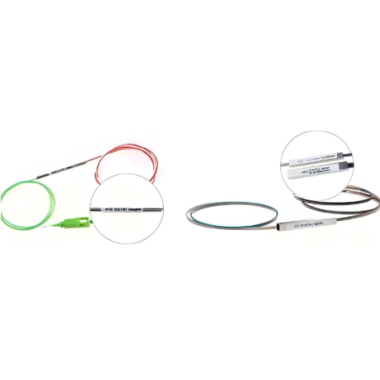
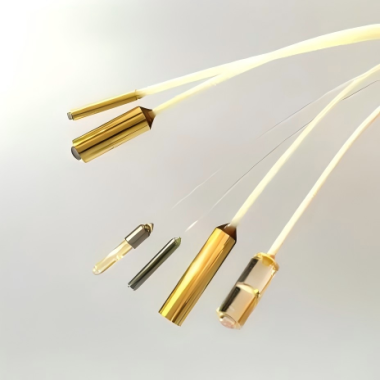
A Faraday rotator mirror combines a Faraday rotator with a reflecting surface. Fiber-coupled designs typically use a collimator to direct light between the fiber and the internal optics.
Also called a Faraday mirror, the device returns light through the same fiber connection while changing its polarization. This controlled transformation makes it useful in systems that send light outward and then collect it along the same path.
2. How Does a Faraday Mirror Work?
For linearly polarized light, the process can be explained in three steps:
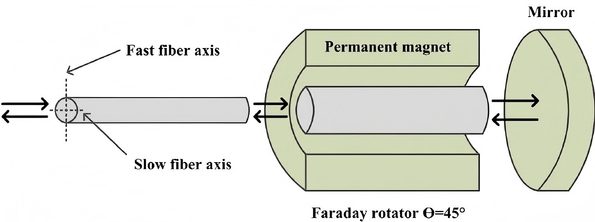
- Light passes through the rotator. Its polarization direction rotates by approximately 45° at the design wavelength.
- The mirror reflects the light. The beam returns through the same rotator.
- The second pass adds another rotation. The total rotation is approximately 90°. At the mirror’s input, the returning linear polarization is ideally perpendicular to the incident polarization.
The second pass adds to the first rotation rather than reversing it. This behavior is called non-reciprocal rotation.
The angles describe the intended operation. Actual rotation accuracy depends on wavelength, temperature and the component’s specified tolerances.
3. Why Use It Instead of an Ordinary Mirror?
An ordinary mirror returns light but does not provide the same non-reciprocal polarization transformation.
As light travels through a fiber, its polarization can change. In an appropriate round-trip arrangement, a Faraday mirror enables compensation for reciprocal polarization changes along that fiber. This assumes that the optical path remains sufficiently stable during the outward and return journeys.
The practical benefit is reduced sensitivity to certain polarization changes—not the removal of every source of instability. A Faraday mirror does not compensate for optical power lost through attenuation or poor connections.
It also serves a different purpose from an optical isolator: the mirror deliberately returns light, while an isolator attenuates light traveling in the unwanted direction.
4. Where Are Faraday Rotator Mirrors Used?
Faraday mirror applications involve optical arrangements designed to use reflected light. Two relevant examples are interferometric systems and selected fiber laser designs.
Fiber Interferometers and Interferometric Sensors
An interferometer combines light from different paths to produce an interference signal. If the returning beams have poorly matched polarization states, the contrast of that signal can decrease.
In a properly configured interferometer, Faraday mirrors can reduce polarization mismatch between returning beams, helping preserve interference visibility. This is useful in sensing arrangements where changes in the interference signal carry the measurement information.
The benefit depends on the complete optical layout; adding a Faraday mirror to an arbitrary sensing system does not guarantee improved performance.
Selected Fiber Laser Designs
Some fiber laser cavities incorporate Faraday mirrors to provide a reflective endpoint with controlled polarization behavior.
Whether this is appropriate depends on the cavity arrangement, wavelength and power conditions. A Faraday mirror is therefore a design-specific component rather than a general upgrade for every fiber laser. Interferometric sensing and fiber lasers are among the applications identified in manufacturer technical literature.
5. What Should You Check Before Ordering?
First establish whether your optical layout requires this type of reflective polarization transformation. Then compare the device specifications with the requirements below.
| Specification | What to check |
|---|---|
| Operating wavelength | The source wavelength must fall within the specified operating band. |
| Rotation accuracy | Check the allowed rotation error and its wavelength and temperature conditions. |
| Optical loss | Confirm how loss is measured and whether connector losses are included. |
| Fiber type | Match the pigtail fiber to the system, including any polarization-maintaining requirements. |
| Connection method | Select compatible connectors and polish types, or bare fiber for splicing. |
| Optical power | Check the power rating and any additional limits for pulsed operation. |
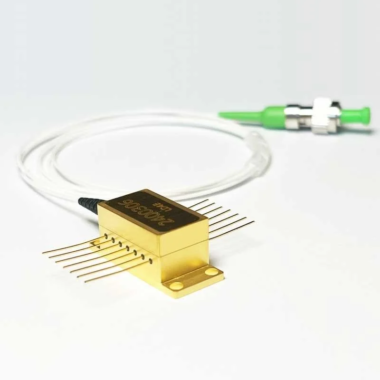
For a 1550 nm design, review Fiber-Life’s 1550nm Faraday Rotator Mirror against your wavelength, loss and connection requirements.
For a design requiring PM fiber, check the available configuration of the 1310/1550nm Polarization Maintaining Faraday Rotator Mirror. Confirm the selected operating wavelength rather than assuming that the product name indicates simultaneous operation at both wavelengths. fiber-life.com
Conclusion
A Faraday rotator mirror does more than reflect light: it changes the polarization of the returning signal in a way that can benefit suitable interferometric and fiber laser designs.
Start with the required optical arrangement, then choose a component whose wavelength, fiber configuration and operating specifications match your system.